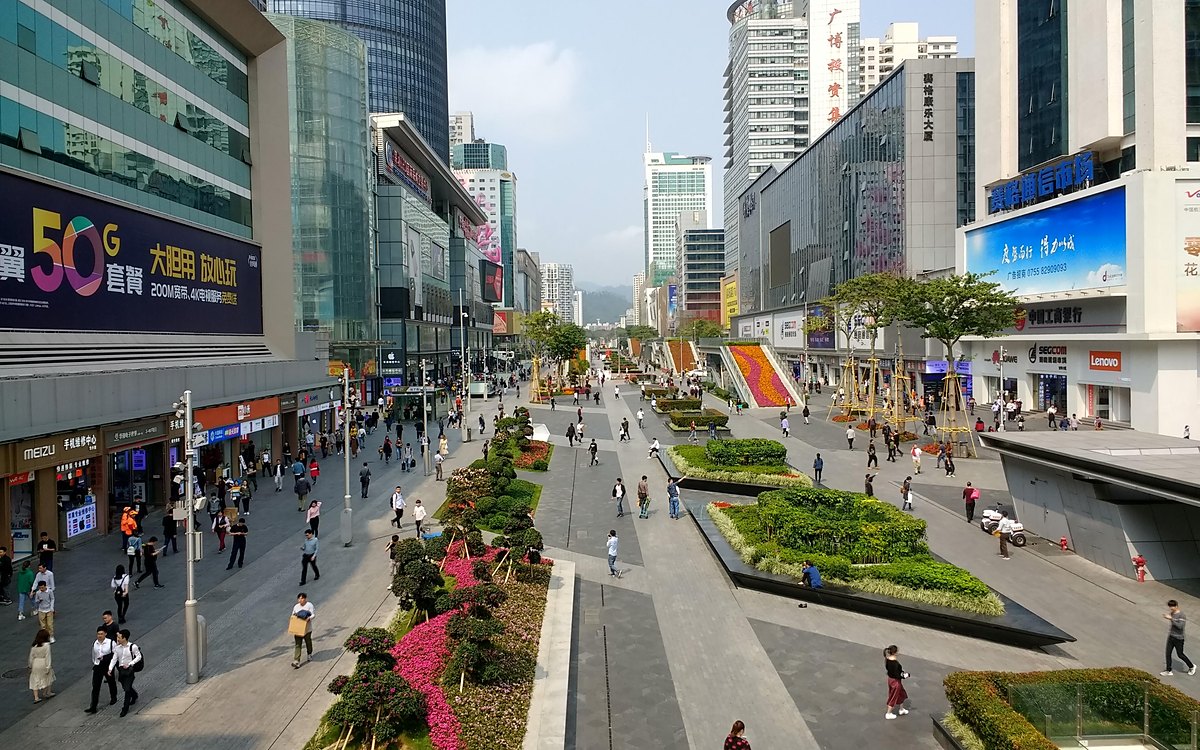
Shenzhen is where the world's gadgets are designed, built and — unlike a museum — handed to you to play with. This 3-day winter itinerary covers 16 tech stops and puts 12 of them on a route: the world's largest DJI store, a 128,000 m² science museum, a robot store where the controller is yours, drone-delivered lunch, and a taxi with nobody in the front seat. All indoor-heavy, winter-friendly and metro-easy, with prices in yuan and dollars.
🌏 South China · Guangdong
🗓️ Suggested: 3 days
Show this to your driver
广东省深圳市福田区
Futian District, Shenzhen, Guangdong
Hotel / city name in Chinese — show to taxi or DiDi drivers
Start here · Winter 2026 & 2027
Planning a China trip this winter? Base yourself in the city that ships the future.
Most first-time China itineraries run Beijing → Xi’an → Shanghai, and those are great trips. But if you pick destinations because of a drone clip you watched at 1 a.m., Shenzhen earns a slot. This is where the hardware in your bag was designed, prototyped and pushed out the door. The difference from a museum is that here you’re allowed to touch it.
Winter is the smart window. December through February in Shenzhen is dry, bright and mild — mid-teens to low twenties Celsius by day, thin-jacket weather — with none of the summer humidity that turns a twelve-hour walking day into a chore. It’s also low season for hotels, with one exception worth planning around: Chinese New Year falls on 17 February 2026 and 6 February 2027, and the week on either side of it is when the whole country is in transit. Book around those dates, not into them.
This is a 3-day block you can drop into a longer China trip — two full days and one light arrival half-day. It’s deliberately indoor-heavy too: six floors of the new Science & Technology Museum, a four-floor robot store, a subterranean electronics bazaar, malls that swallow whole afternoons. A cold snap or a wet afternoon costs you a plan B, not a day.
Every stop below is rated for how much you can actually do — fly a drone, print a figurine and carry it home, hail a taxi with nobody in the driver’s seat, take the controller and make a robot dog sit — and carries the time it realistically takes, so you can plan the day instead of guessing. Prices are in yuan with US dollars alongside, so you can budget before you land. Jump to the 16 stops, or see the 3-day route.
At a glance
Item
Detail
Best months
Dec–Feb · dry, 15–22°C
Skip
Spring Festival week (17 Feb 2026 · 6 Feb 2027)
APEC summit
18–19 Nov 2026 · road controls, extra light shows
Days needed
3 (2 at a pinch)
Budget
~¥2,200 / ~US$315 pp
English
Patchy — apps do the work
Arriving
High-speed rail or SZX airport
Visa
Check current visa-free / transit rules
Metro
Best in China · almost every stop is on a line
🚄
Coming from Hong Kong?
The high-speed rail from West Kowloon takes 14 minutes once you've cleared both sides — see High-Speed Rail in China. And set up Alipay before you arrive: half the experiences on this page are booked or paid in-app.
Why Shenzhen: not a museum of the future — the factory floor of it
Shenzhen builds the world’s gadgets, then lets you play with them. This itinerary skips the generic tourist circuit — no crowded beaches, no miniature-world parks — and goes straight to the one thing that makes tech travel worth it: the chance to actually do something. Fly, print, ride, drive, trigger. Every stop below was visited and vetted by a traveler, not a brochure.
Hands-on, not look-don’t-touch
From flying drones to printing your own figurine to steering a robot dog through an obstacle course, most stops are built to be played. Every one carries a hands-on rating, so you know before you go whether you’ll be doing or watching.
Flat, walkable, metro-easy
Clusters are grouped by district so you minimise transit. One traveler did five days here almost entirely on the metro — two taxi rides in total. Shenzhen’s network is the cheapest and cleanest big-city metro in China, and every stop below sits within a few minutes of a station.
Built for all ages
Grandparents, kids, tech nerds — everyone finds something to touch. The route is paced so nobody burns out, with parks and waterfront between the high-tech hits, and every stop has a bench, a café or a mall attached.
The 16 stops
Each stop is one card: the photo, what it is, and the numbers you plan with — time, money, how to get there. The label on the photo is the cluster it belongs to. Open Full details for the play-by-play. A handful of the photos are illustrative — they show the experience rather than that exact room on that exact day.
12 of these 16 make the 3-day trail. The rest are 15–60 minute add-ons for when you’re already nearby. Prices in CNY (¥) with approximate US dollars, at ¥7 ≈ US$1.
1Drones & Robots
DJI Flagship Store
The largest DJI on earth, and half of it is a flight deck
Nearly 4,000 m² over four floors, standing on the Shenzhen Bay waterfront at Happy Coast. This is DJI's biggest store anywhere, rebuilt from the ground up on the site of the original 2015 shop, and it doesn't behave like a shop: sales take up one floor, and the other three are a drone park, a photography gallery and a 15-metre auditorium.
📍 Happy Coast, Nanshan
🕐 70 min
💸 Free
🚇 Line 9 Shenzhen Bay Park, exit E
📍 深圳市南山区滨海大道2008号 欢乐海岸 大疆旗舰店
Full details
Why it's worth the trip. Shenzhen is where DJI is from, and this is the only place in the world where you can watch consumer drones fly over an actual bay from inside the building that sells them. The agricultural sprayers, firefighting rigs and cargo haulers on the back wall never appear in normal retail — you're looking at the company's industrial half.
How to play it. Ground floor to handle the foldables and test the gimbal on an Osmo; second floor out to "DJI Park", a test-flight terrace with a control tower and a view straight down the bay — staff run demo flights and you can stand under them; third floor for the Hasselblad space and the joint photo exhibition, which is genuinely a gallery, not a display case.
Best route. F1 (20 min) → F2 flight deck (25 min, best light mid-afternoon) → F3 photos (15 min) → skip F4 unless something's on. Enter from the Happy Coast boardwalk side so you come in at the water.
2Drones & Robots
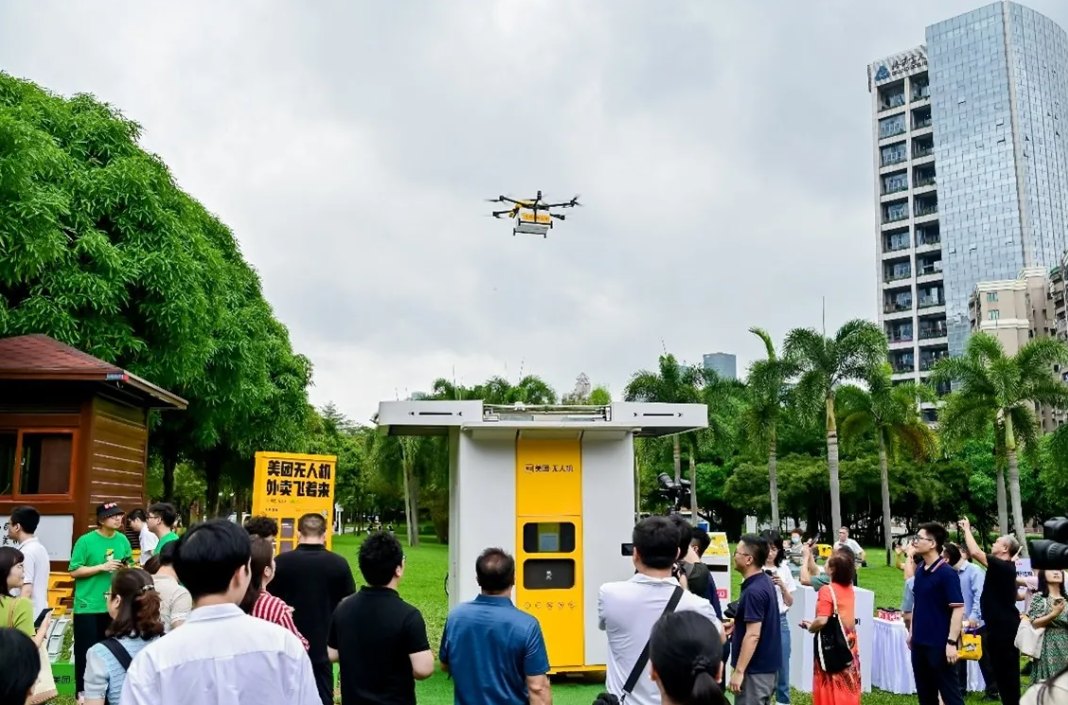
Meituan Drone Delivery
Order lunch, watch it land
This isn't a demo. Shenzhen runs the world's first routine drone-delivery network — over a million orders logged, dozens of routes, a locker in most big parks.
📍 Talent Park · Shenzhen Bay Park · Lianhuashan south gate
🕐 20–30 min
💸 ¥30–70 / US$4–10
📍 深圳市南山区 科苑南路 人才公园 美团无人机外卖取餐点
Full details
Why it's worth the trip. Every city has a drone show. Almost none has drone infrastructure you can use as a tourist for the price of a coffee. The moment is small and completely absorbing: the drone hovers, the arm cycles, the hatch opens, and the person next to you is a local doing this on their lunch break.
How to play it. Open Meituan, set the delivery address to a locker (Talent Park's tidal plaza is the busiest and the most photogenic), pick from the shops that light up as drone-capable, pay. You'll get a pickup code; open the locker, take the box, then fold the insulated container and drop it in the recycling slot next to the cabinet — that part is expected of you. Load limit is 2.3 kg, so a drink plus a rice box is fine and a hotpot is not.
Two things to know. The Meituan app is Chinese-only, and signing up usually wants a Chinese number — ask your hotel to order for you, or use a travel companion app. And drones stay grounded in wind, heavy rain or fog, with the order quietly reverting to a rider.
Best route. Order from the metro, walk to the park, and time your arrival to the notification. Then walk the bay while you eat.
Come back after dark. The same park runs Shenzhen's other big free light show: the Houhai towers firing in sequence, plus — new for the APEC summit — a water-screen show on π Lake — a ring of fountains firing jets up to 80 metres, with laser and projection thrown through the mist and the China Resources "Spring Bamboo" tower behind. Friday, Saturday and public-holiday nights at 19:00, 20:00 and 21:00 from November to March (19:30, 20:30 and 21:30 April–October). Free, no booking. Watch from 星光桥 (Starlight Bridge) for the full frame with the towers behind the water, or π Bridge for the reflections.
3Drones & Robots
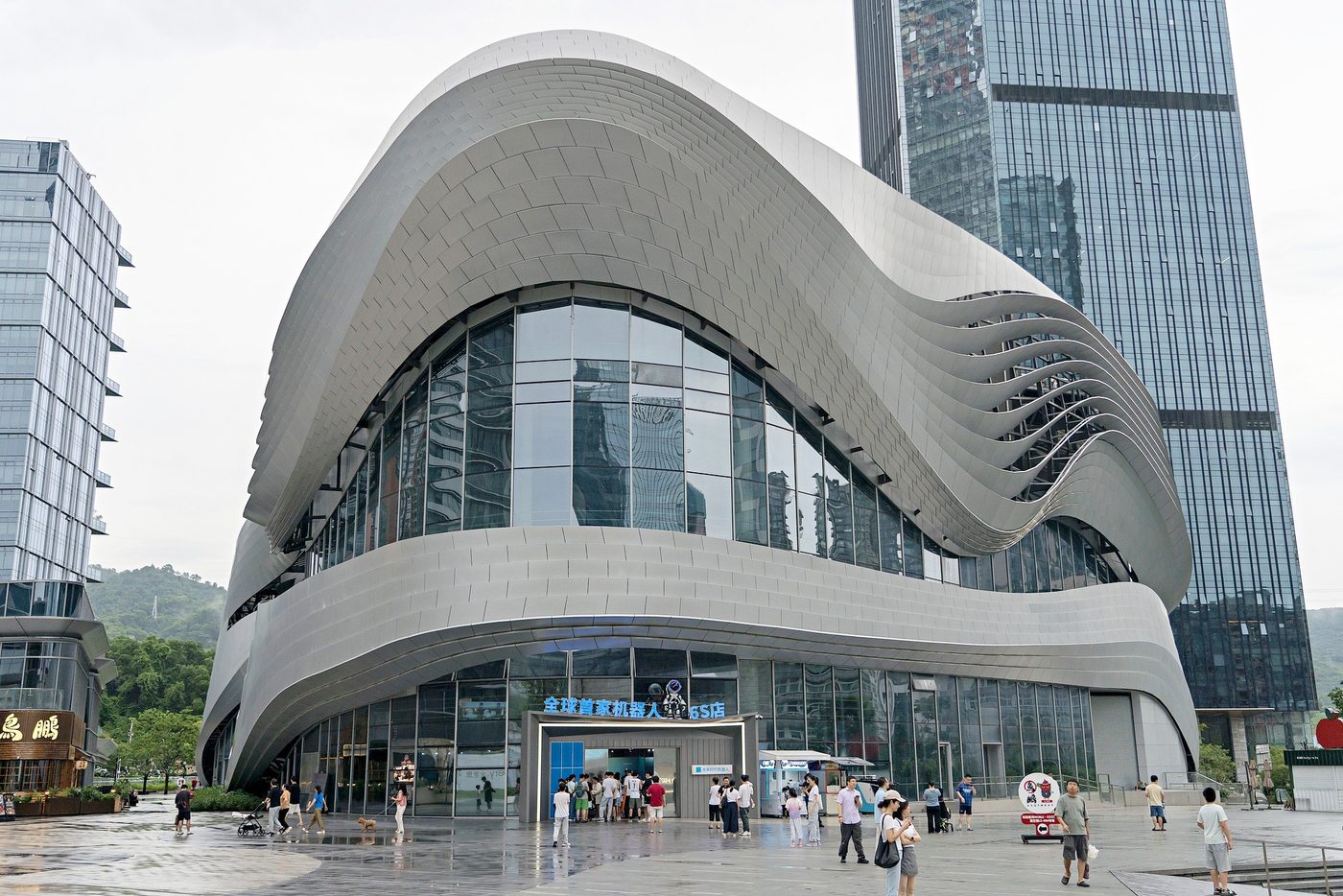
Robot 6S Store
The world's first, and you can buy or rent everything in it
Four floors in Bantian, opened in July 2025, and the first retail space anywhere built on a "6S" model: sale, spare parts, service, feedback, rental and customisation. More than 100 companies and 300-plus robots are represented, and roughly 550,000 people have walked through — close to 180,000 of them from overseas.
📍 Galaxy WORLD, Bantian, Longhua
🕐 75 min
💸 ¥49 / US$7
🕙 10:00–18:00
📍 深圳市龙岗区坂田街道 星河WORLD园区 机器人6S店
Full details
Why it's worth the trip. You get the full range in one building: piano-playing hands, a coffee robot pulling shots, patrol bots cruising the aisles, a car robot that transforms, ping-pong and chess machines, and a full-size humanoid that will shake your hand. Weekend shows run at 11:00 and 16:00 out front, and the crowd is half local families, half foreign tourists.
Robot dogs. The Unitree experience hall that opened at UniWorld in Longhua in 2025 has since closed, which leaves this building as the one place in Shenzhen where the controller ends up in your hand instead of a staff member's.
How to play it. Ground and second floor for the humanoids, service robots and the show; third floor is where it gets physical — send a robot dog through the obstacle course, put one in a robot-dog duel, race a car with your brainwaves, and strap into an exoskeleton that lifts more than you can. Interactive items on 3F cost a little extra on top of entry.
Tickets. ¥49 self-guided (1F–2F). ¥199 guided, three people minimum. ¥418 for the 1F–3F interactive pass. ¥568 for everything plus a guide. Pay at the door.
Best route. Arrive 15 minutes before a show → 1F/2F with the crowd → 3F interactive once the tour buses leave. The whole Robot Block street outside is worth 20 minutes on the way out.
4Maker & 3D Culture
Bambu Lab
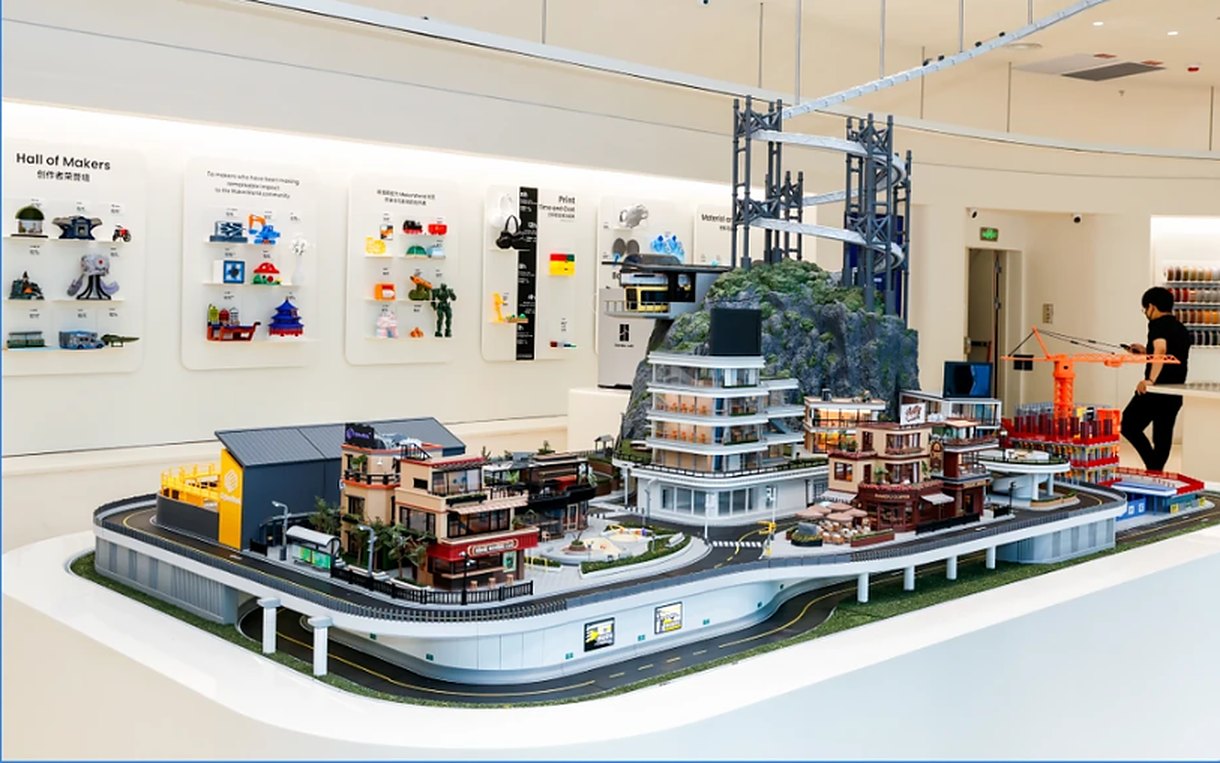
The world's first 3D-printing store, and the print is free
Bambu Lab was founded in Shenzhen in 2020 by a team out of DJI and became the world's biggest consumer 3D-printer brand inside five years — about a third of the global market.
📍 Shenzhen Bay MixC Phase 2, B1 (B131-13), Nanshan
🕐 30–60 min
💸 Free print, free class
🚇 Line 2/11 Houhai, exit F
📍 深圳市南山区 深圳湾万象城B区B1层 拓竹3D打印旗舰店
Full details
Why it's worth the trip. Two things hold the room. The printed city on the low table in the middle — towers, a ring road on stilts, trains running, a hillside with a car park cut into it — all of it run off the machines behind you. And the printer wall itself: dozens of machines working at once, each on something different, which is the kind of thing you otherwise only see in a factory video. Then you get to take your own print home.
How to play it. Sign up at the desk the moment you walk in; classes are same-day, in person only, ten seats each, at 11:00, 15:00 and 16:30 (plus 20:00 at weekends). The 45-minute intro explains what's actually happening, then you choose from a preset library and run the print yourself. Between sign-up and class, go shopping — that's the design.
Timing. Queues form before opening at weekends. Weekday mornings are calm.
5Maker & 3D Culture
inno100
Kickstarter's first shop in China — a good look, not a playroom
Kickstarter's first authorised offline space in China: 1,100 m², 100-plus brands, in the north hall of Shenzhen Bay Culture Plaza, and the store TIME held up as an example of hardware coming off the screen. The catch is that much of it is display-only or runs on someone else's schedule — the humanoids walk when a demo is booked, and the DIY bench is a session you arrange, not a counter you walk up to.
📍 Shenzhen Bay Culture Plaza north hall, L1, Nanshan
🕐 20–30 min
💸 Free to walk in; demos and workshops by arrangement
🚇 Line 13 Talent Park, exit B1
📍 深圳市南山区 深圳湾文化广场北馆L1层 INNO100全球创新旗舰店
Full details
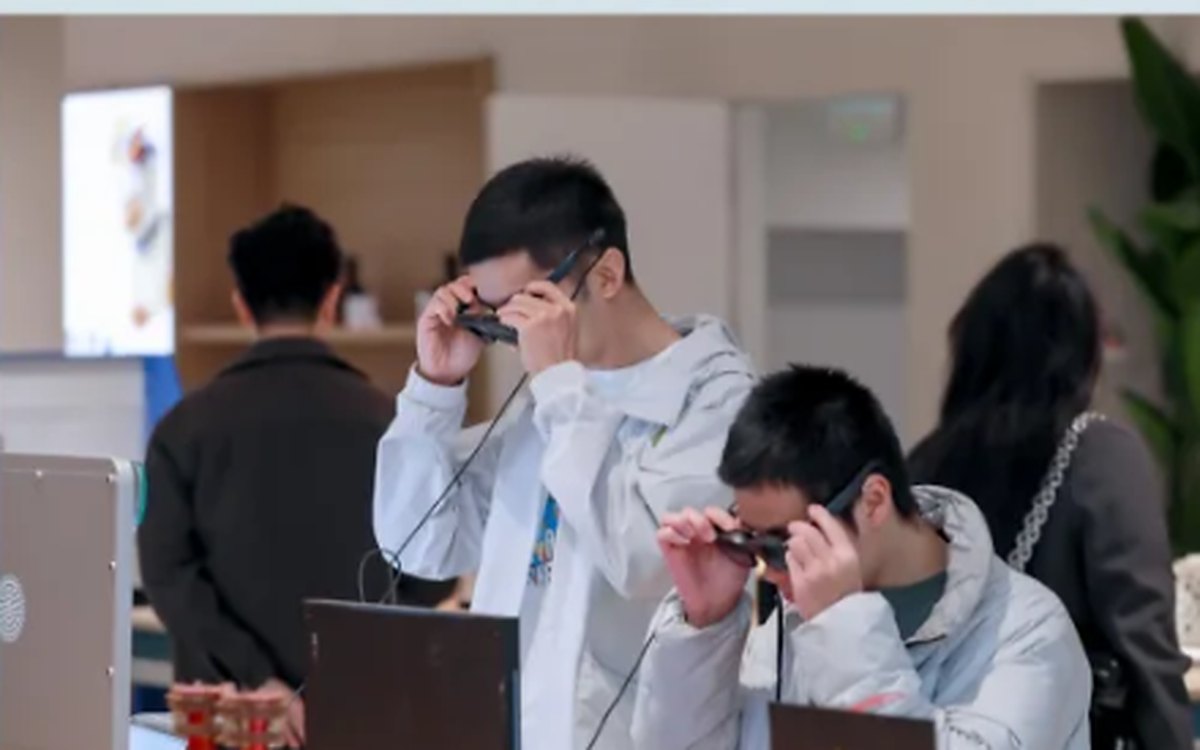
What's actually in there. Crowdfunding hardware in the flesh: the UV printer that raised over US$46m on Kickstarter, a laser engraver, an exoskeleton you can strap on, folding keyboards, a wheel-legged robot pacing the floor, AR glasses. In the flesh is the point — these are products most people have only seen as a campaign page.
Set your expectation. It's a showroom. Machines sit idle, robots stand still, and the ones that do move do it on a schedule. Plenty of visitors arrive expecting an arcade and leave flat, and the reviews saying so are fair. Come at it as a 20-minute look at what Shenzhen is shipping next and you'll enjoy it.
If you want to touch something. Ask first — 「请问这个机器人今天可以现场演示吗?几点?」 (is this robot being demonstrated today, and at what time?). If you want to make something rather than watch, walk five minutes to Bambu Lab in the MixC: there you sign up, print and take it home the same day, no appointment. Do inno100 as the appetiser, not the main course.
6Maker & 3D Culture
Huaqiangbei
The densest electronics market on the planet
Not a mall. A district: 35 electronics markets, around 115,000 businesses, more than ¥400 billion of trade a year, and roughly 7,000 overseas buyers walking through on a normal Tuesday. Akihabara is a pool; this is the Pacific. Almost every phone, drone, earbud or robot on this page was prototyped within a few kilometres of where you're standing.
📍 Huaqiangbei, Futian
🕐 90 min
💸 Free to enter
🚇 Line 2/7 Huaqiangbei, exit A
📍 深圳市福田区 华强北路 赛格电子市场
Full details
Why it's worth the trip. Even buying nothing, the sensory hit is worth the metro fare: floors of components, LED walls, phone shells by the hundred thousand, and the low hum of a market that supplies half the world. And the Huaqiangbei Museum on the fifth floor of the Modern Window Building tells you how a rice field became this, which reframes everything you just walked past.
How to play it. Do it in this order — SEG Plaza (the original, sharpest prices), then Huaqiang Electronics World (easiest for first-timers, best for earbuds, GaN chargers and cables), then the museum, then E-World for finished gadgets. Test everything before you pay, ask for the chip model rather than "original", and on unbranded goods open at 60–70% of the asking price — the counter expects it. Anything branded suspiciously cheap is a copy; walk on.
Timing. Tuesday to Thursday, 10:00–15:00, when stallholders have time to let you try things.
7AI & Immersive
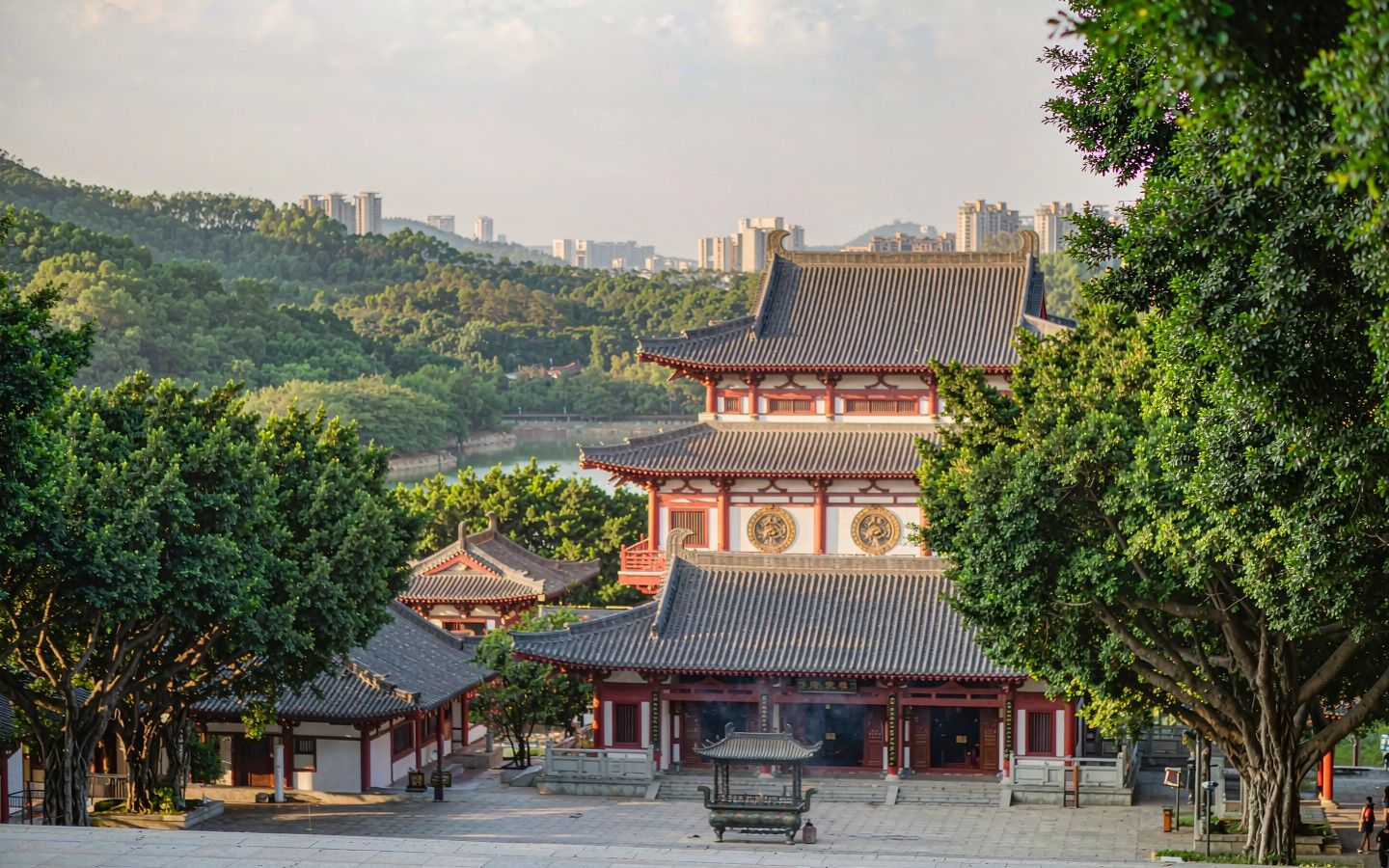
Bore Zen Temple
Founded 1278, rebuilt 2015, free lunch at 11:15
The oldest thing on this itinerary, and the strangest pairing: a working Buddhist temple inside Yabao Park in Bantian, three sides of hills, a reservoir below, tower blocks on the skyline.
📍 Yabao Park, Bantian, Longhua
🕐 45 min
💸 Free
🚇 Line 10 Yabao, exit A1, 5–10 min walk
📍 深圳市龙岗区坂田街道 雅南路12号 雅宝公园内 般若禅寺
Full details
The history, properly. This was originally Pangu Temple, founded in 1278 — the 15th year of Kublai Khan's Zhiyuan era. It was rebuilt twice under the Ming, in the Hongzhi and Chongzhen reigns, and rebuilt again in 1688 after the river washed the site out; all of it is recorded on steles in the courtyard. What stands today is a 2015 reconstruction funded by the Xinghe Group under Master Yinshun, and it serves as a branch monastery of Shenzhen's Hongfa Temple. It covers a little over 5,000 m² and holds eleven halls.
Why it's worth the trip. Two reasons, and they're opposites. First, it's the only place in this city where you can stand in a Ming-documented courtyard while a robot vacuum hums past the incense burner. Second, the temple has leaned into the contrast: you can copy a sutra by hand, sit a short guided meditation, and talk to a screen-mounted "little monk" that answers questions about practice — old ritual, new code, in one quiet hour.
The route. Gate → Hall of the Four Heavenly Kings → the main Mahavira Hall → the Reclining Buddha hall off to the side → Guanyin Hall → the God of Wealth hall → out to the pavilion above the reservoir, which is where you'll want to sit. Take three sticks of incense from the stand on the left of the entrance — free, and expected.
The free lunch. Vegetarian meal served 11:15–12:00, no charge, mostly vegetables the temple grows itself. Turn up by 11:00, queue with everyone else, and don't talk through it. It's the best-value hour in Shenzhen.
Timing. Open 06:00–19:30. Ten minutes' walk from the robot store, which is why they sit next to each other on Day 2 — go from the loudest room in the city to the quietest in one hop.
8AI & Immersive
Orbit One
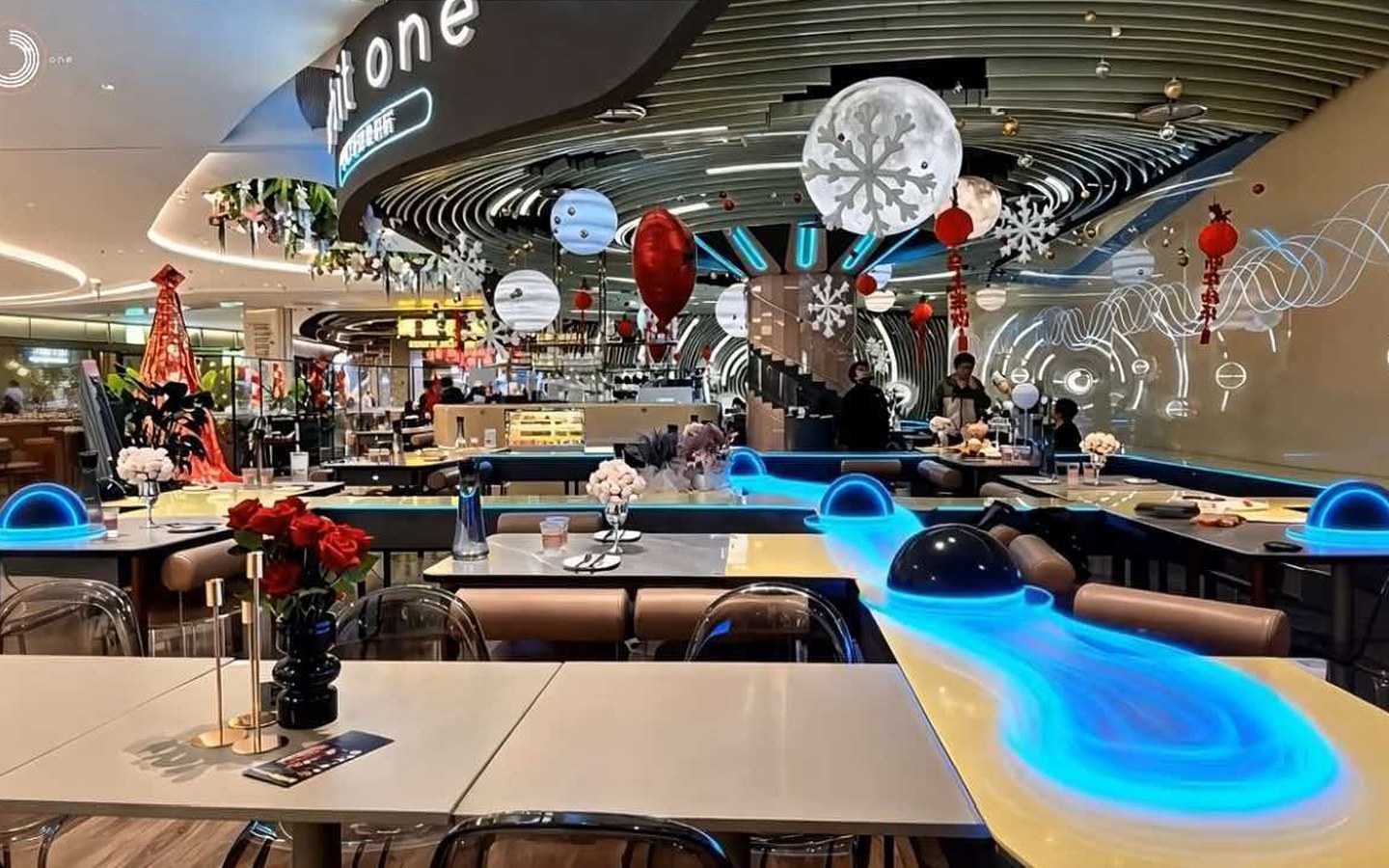
Meals arrive by magnetic-levitation UFO
A space-themed Western restaurant on the LG floor of iN City Plaza in Futian, and the only place on this list where the technology is aimed at your table. Dishes are loaded into UFO-shaped carriers that run a track along the ceiling, glide to your position, and descend to hand over the food.
📍 iN City Plaza, LG floor, Futian
🕐 90 min
💸 ¥80–150 pp
🚇 Line 1/6 Science Museum, exit F
📍 广东省深圳市福田区 南园路 iN城市广场 LG层 01-02号
Full details
Why it's worth the trip. It's the one meal you'll film all of. Roughly 2,250 reviews on Dianping and a 4.7 average says it isn't only a gimmick — the kitchen holds up. Order the pineapple fried rice served inside a whole pineapple, the grain-fed sirloin, or the black tiger prawn creamy pasta; the 500 g tomahawk is the group showpiece.
How to play it. Ask for a table under the track (some are, some aren't — the delivery only works on part of the floor), and take a "planet" booth if you have kids. Children's "Little Astronaut" set runs about ¥19.9, which is the cheapest entertainment in the city.
Practical. Around ¥80–150 a head. Book at weekends. There's a second branch at UniWorld in Longhua if you're staying north.
9AI & Immersive
Shenzhen Science & Technology Museum
950 exhibits, start at the top
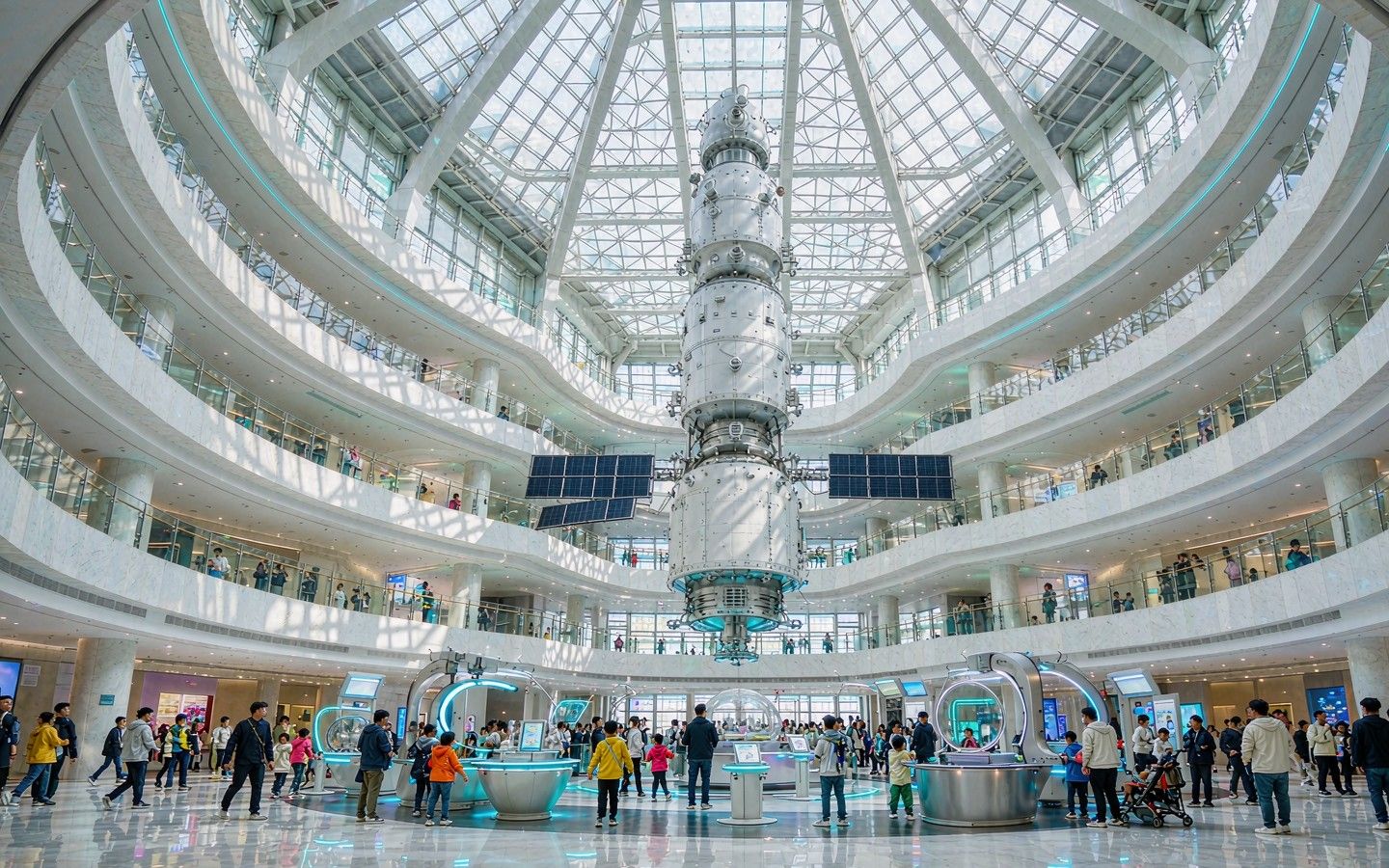
The new museum in Guangming is the largest science centre in China: 128,000 m², roughly 950 interactive exhibits across 24 themed zones, six specialty cinemas, and a claim to be the world's first museum built around "digital civilisation". Almost everything in it responds to being touched.
📍 Guangming
🕐 3 hrs (pick three halls)
💸 ¥50 / US$7
🚇 Line 6 Guangming, exit C/D, walkway straight to 2F
📍 深圳市光明区 光辉大道8号 深圳科学技术馆
Full details
Why it's worth the trip. Because of the scale of the thing. This isn't a room of buttons — it's six floors of professionally built interactives, from a 1:1 Tianhe space-station core module you can climb inside to a robotic arena where machines play basketball and football, a future-car factory that takes you from sketch to assembly line, and a fifth floor on the universe that is the most photographed space in the building.
The route that works. Start on 5F and work down: universe → 4F smart industry (new materials, advanced manufacturing, Shenzhen's own industrial chain) → 3F better life (AI, smart home, communications) → 2F "Hello, World" → 1F for the cinemas and the science shows. Going top-down isn't just about crowds — it means you spend your freshest hour in the best hall, instead of arriving there at closing time like everybody who started at the entrance.
Book two things on arrival. The 奋斗者号 submersible simulator and the flyer experience both hand out numbered slots at the zone desk — 10 people per session — and they're gone within the hour. Go straight there after the gate.
Booking. Timed entry, no walk-up tickets, closed Mondays. Slots release at 20:00 roughly three to six days ahead on the museum's WeChat mini-programme, or via Meituan, Dianping or Ctrip. ¥50 adult, ¥32 concession, free under 6 and over 65; the giant-screen cinema is +¥30. You can leave and re-enter on the same ticket, and you scan the passport you booked with at the gate.
10Future Mobility
Baidu Apollo Go
A taxi with nobody in the driver's seat
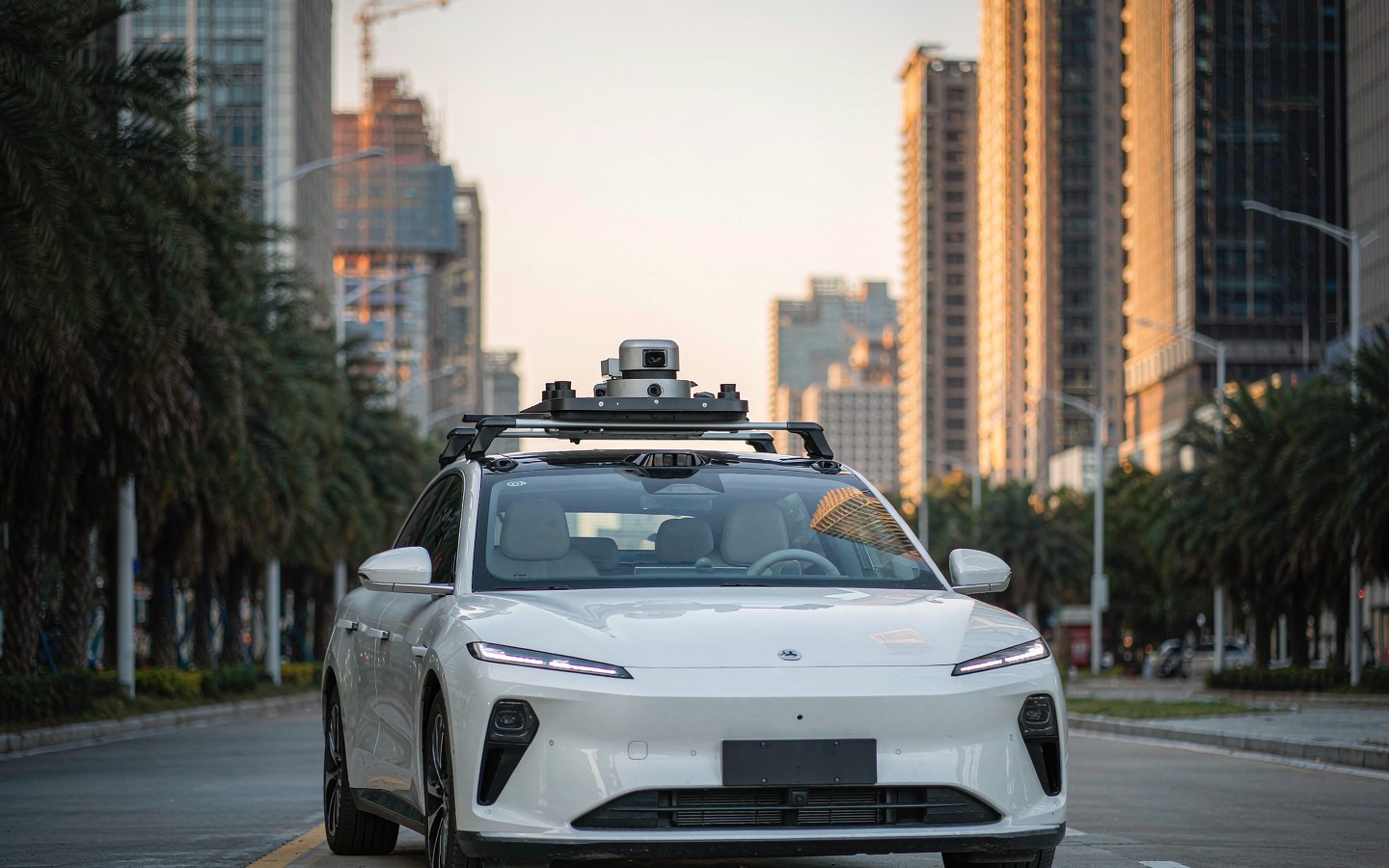
Apollo Go (萝卜快跑) runs paid rides with nobody in the front in Nanshan, Bao'an and Pingshan — not in Futian. Pick up at the Shenzhen Bay Sports Centre south gate, buckle up in the back, and watch the wheel in front of the empty seat turn itself.
📍 Shenzhen Bay Sports Centre, south gate (Nanshan)
🕐 20–25 min ride
💸 App fare, ~¥10–30
🚇 Houhai, exit M
📍 深圳市南山区 滨海大道3001号 深圳湾体育中心 南门
Full details
Why it's worth the trip. Because it quietly stops being a novelty about four minutes in. You get in the back, the car pulls away smoothly, and then you notice you've stopped checking whether anyone is driving.
Where it actually runs. Nanshan, Bao'an and Pingshan. In Nanshan the tourist-friendly stops are the Shenzhen Bay Sports Centre south gate (深圳湾体育中心南门), Sea World, the Shenzhen Bay MixC, Coastal City and Talent Park. Uber-style pin-on-a-map pickup doesn't exist: you choose from fixed stops, so open the app first and look at the dots nearest you before you walk anywhere.
How to get in. Shenzhen Bay Sports Centre is a 10-minute walk from Houhai station exit M (Lines 2, 11 and 13) — walking under the white "Spring Cocoon" shell is the landmark. Stand at the south gate, order on the 萝卜快跑 mini-programme inside WeChat or the standalone app, and when the car arrives type the last four digits of your phone into the panel on the door pillar. Rear seats only, seatbelt on or it won't move, tap start on the screen. The screen also runs the AC and the music.
What it's like. Polite to a fault. It holds 30–40 km/h, stops fully for anyone near the kerb, and will sometimes wait at a junction far longer than a human would. Fares are cheap — often under ¥10 for a short hop with a new-user credit, and it runs 24 hours.
Best route. Order the pickup at the sports centre south gate and drop at Sea World (海上世界) — about 8 km west along the coast, 20 minutes, roughly ¥20. It's a real end-to-end driverless trip rather than a three-minute demo, and Sea World has the restaurants plus a free music-and-light fountain on the water in front of the Minghua ship — every half hour from 19:00, last one at 21:00 Tuesday to Thursday and Sunday, 21:30 on Friday and Saturday. It's the easy Nanshan alternative if you'd rather stay south than cross to Bao'an for the Bay Glory night — order it from Talent Park or the sports centre after the drone pad.
11Future Mobility
The driverless minibus (B888)
Free, and you can book a seat from the airport train
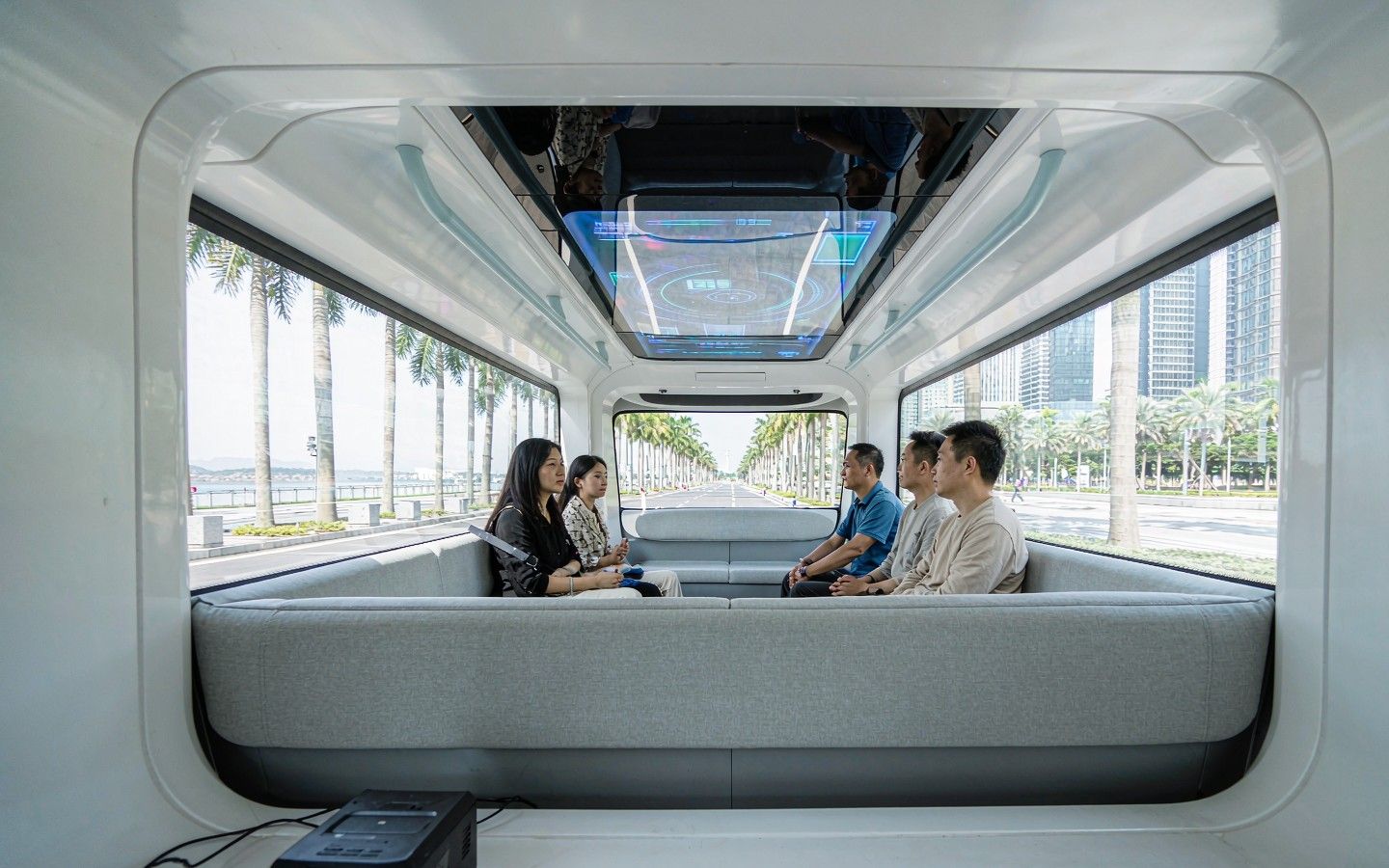
Route B888 has run since August 2025 between Luohu Port and Sungang with no driver's cabin, no wing mirrors and a detachable steering wheel. Six passengers a vehicle, free, reservation only — and it's the lowest-effort way in China to sit inside a car with nobody at the controls.
📍 Luohu Port smart stop, Luohu
🕐 25–30 min one way
💸 Free, book ahead
🚇 Luohu, exit A2
📍 深圳市罗湖区 人民南路 罗湖口岸 无人驾驶小巴智慧候车亭
Full details
Why it's worth it. It costs nothing, takes half an hour, and unlike the robotaxi it needs no Chinese ID for verification — reserve, scan a code, sit down. Locals use it to get to the shops, which is the least staged autonomous ride you'll take all trip.
The line. B888 runs Luohu Port ↔ Sungang Wanxiang Shijia in both directions, stopping at Guomao, Diwang Tower, the Grand Theatre and MixC. Roughly 5.7 km one way, 25–30 minutes, and the audio commentary runs in Mandarin, Cantonese and English — get on at Luohu Port and it doubles as a loop through the old city.
How to book. Search 深巴出行 in WeChat, verify, pick B888, choose your boarding stop and a departure slot, then scan your code at the shelter. There are only three vehicles and six seats each, and no walk-ups — turning up without a reservation means watching the bus leave. Weekend slots go first, so book the morning of. Visitors from Hong Kong can book on the KMB APP1933 app instead, which skips the WeChat registration.
Practical. 08:30–19:00 daily. A safety steward rides along but never touches the controls — the vehicle drives itself, and you can watch the sensor view on the cabin screen. The Luohu Port shelter has a small exhibition hall attached, so arrive early and let the kids press buttons while you wait.
12Future Mobility
Sightseeing bus
The leg-rest move
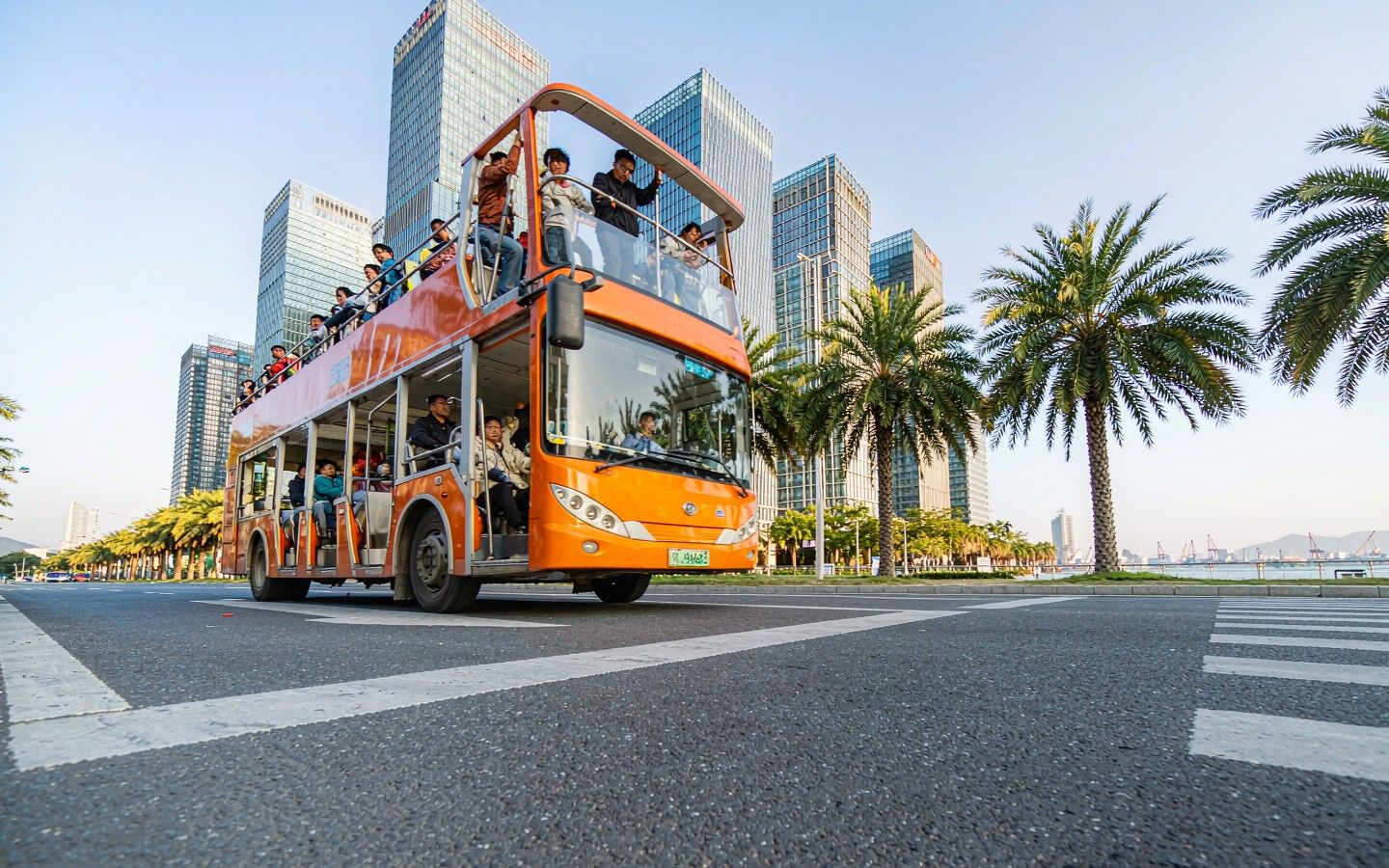
Open-top double-deckers loop between the coast and downtown on a hop-on, hop-off day pass.
📍 World Window exit I, tourist centre, Nanshan
🕐 1–1.5 hr loop
💸 Day pass
📍 深圳市南山区 世界之窗地铁站I出口 深圳旅游观光巴士游客中心
Full details
Why it's worth it. Not for the commentary, for the sitting. With kids or grandparents in the group, one loop buys everyone two hours of recovery without losing the day.
13Urban sci-fi landmarks
Gangxia North "Shenzhen Eye"
The biggest metro station in the country
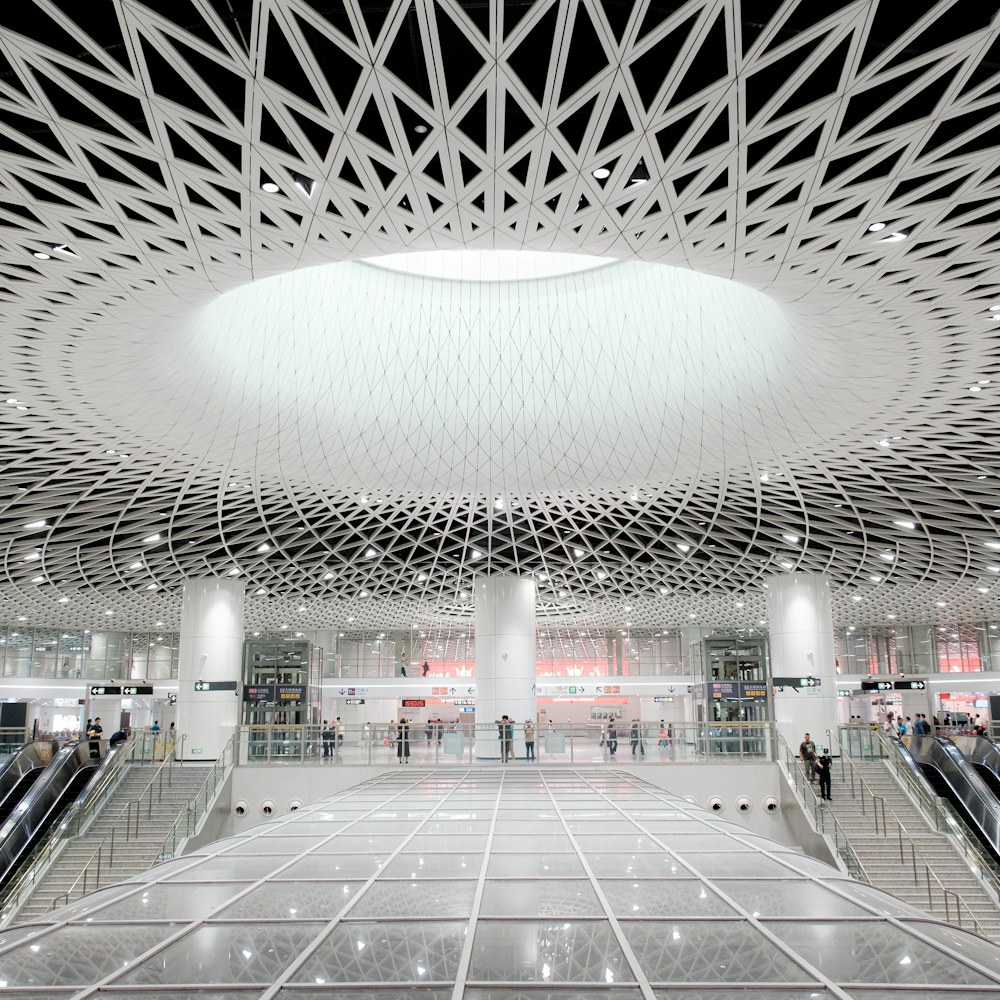
224,900 m², five lines crossing, 23 exits, five levels stacked underground, and around 400,000 people through it on a working day. It is the largest single rail-transit structure in China, and for about ten minutes after you arrive you will not believe it's a station.
📍 Gangxia North, Futian
🕐 15 min
💸 Free
🚇 Lines 2/10/11/14
📍 深圳市福田区 岗厦北地铁站 深圳之眼
Full details
Why it's worth the trip. The dome. A 48-metre white lattice built on a Fermat spiral, with a nine-metre oculus dropping daylight into the concourse — and beneath it the world's first fully transparent glass tunnel, where trains slide past under your feet. The 128 columns around the hall are deliberate: they stand for the 128 old apartment blocks the hub replaced. Even the gates are science fiction — palm-print payment and face recognition — and there's a metro art museum off the Line 10 concourse plus badminton, pickleball and table-tennis courts tucked into the dead space.
The three photographs everyone gets. Straight under the big oculus, 11:00–14:00 when the light column is vertical; mid-handrail with a wide lens for the full dome; and the junction where the stair rail meets the platform, which is the one that looks like a film still.
Practical. Free, and it's on the way to almost everywhere — stack it onto Day 2 rather than making a trip.
14Urban sci-fi landmarks
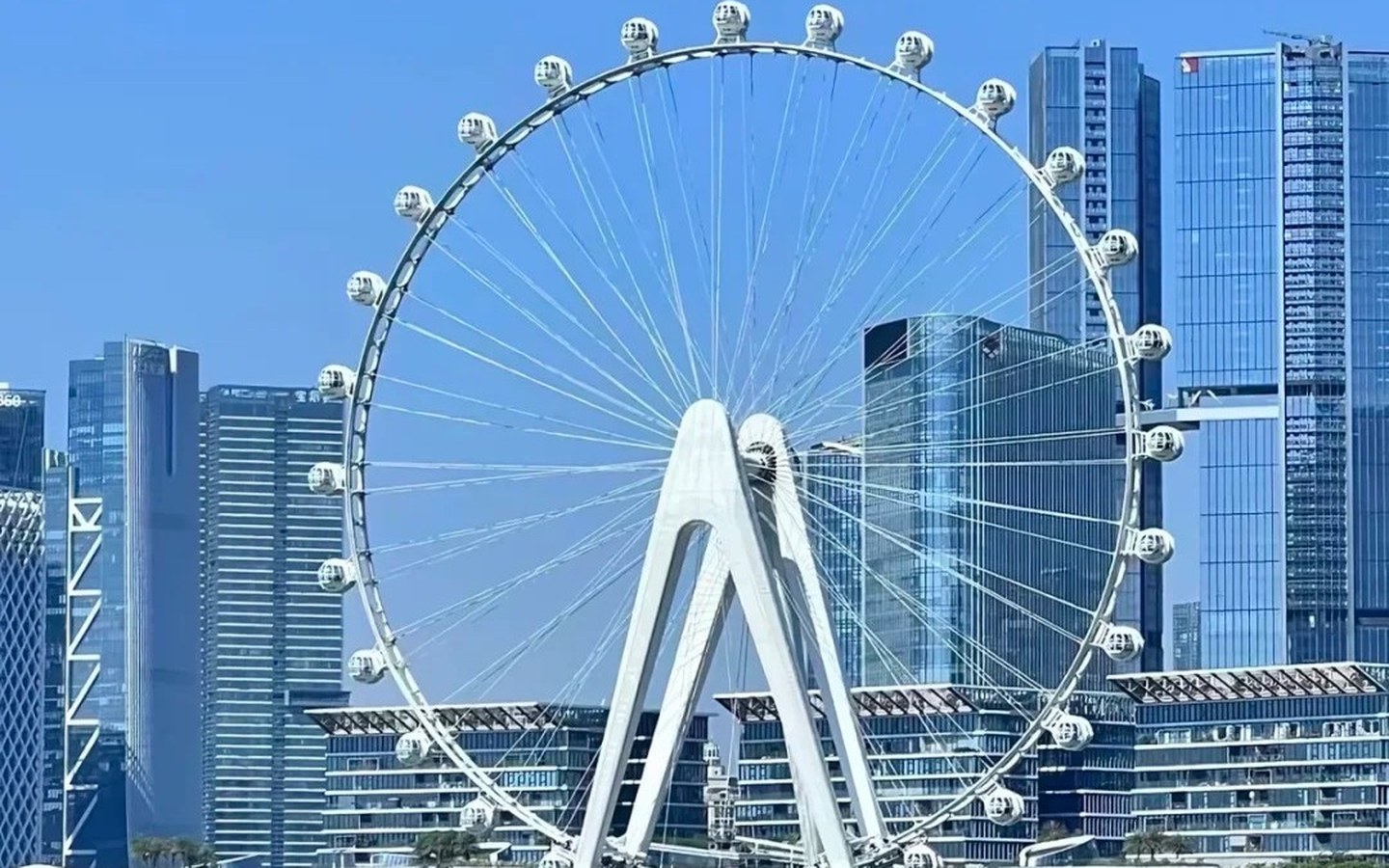
Bay Glory Ferris Wheel
Ride it after dark for the skyline
128 metres, 28 glass cabins, on the Bao'an waterfront at Happy Harbor. Shenzhen's tallest wheel, and deliberately slowed to about 28–30 minutes a revolution so you have time to look.
📍 Happy Harbor, Bao'an
🕐 45 min
💸 ¥150 / US$21
🚇 Line 5 Linhai, exit B2
📍 深圳市宝安区 欢乐港湾 湾区之光摩天轮
Full details
Why it's worth the trip. The timing. Board between 17:00 and 18:00 and you get the sun going down over the Pearl River estuary on the way up and a lit-up skyline on the way down. In December sunset is around 17:45, so the window is narrow and worth planning.
Make an evening of it. The plaza below runs 《鲲鹏之梦》, a free water-and-light show with a 15-metre water screen and projection — 20:00 on weekdays, 19:30 and 20:30 at weekends, dark on Mondays. Stand in the middle of the crowd, not the front row, unless you want to get wet.
Practical. ¥150 weekday, ¥180 holidays, ¥80 for children 1–1.4 m and over-65s, under 1 m free. 10:30–22:00. Buy on the official mini-programme to skip the queue.
15Urban sci-fi landmarks
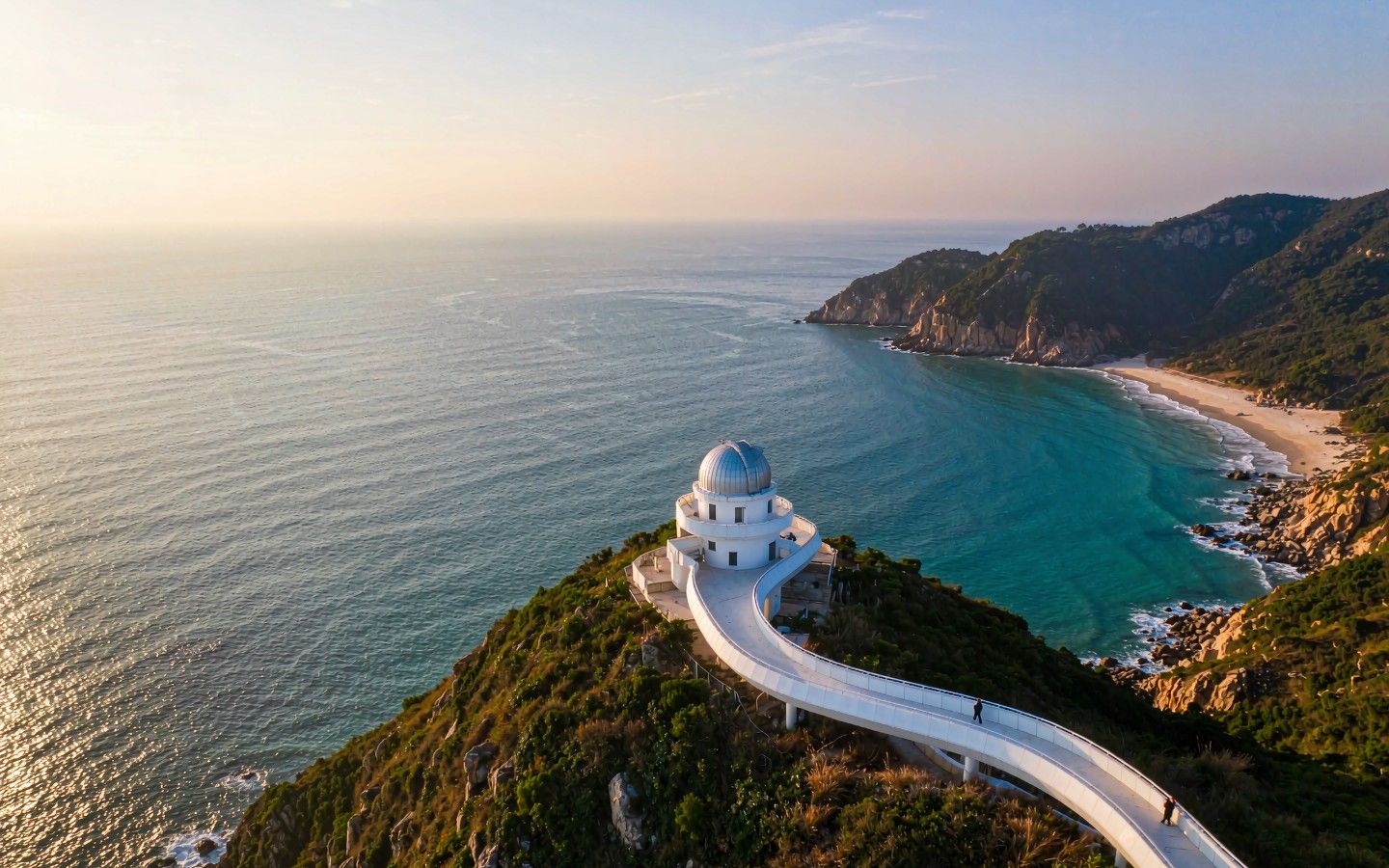
Shenzhen Observatory
The S-curve above the sea
A cliff-top observatory on the Dapeng peninsula, at the end of a white S-shaped boardwalk above Xichong beach. The coastline below is the one China National Geographic puts among the country's most beautiful, and by night Xichong is China's first International Dark Sky Community.
📍 Xichong, Dapeng
🕐 90 min + 3 h travel
💸 Free, book the observatory
🕘 Tue–Sun only for the buildings
📍 深圳市大鹏新区 西涌 深圳天文台
Full details
Why it's worth the trip. It's the only place in this guide with nothing to switch on. You walk a boardwalk that hangs over the water, look out at open sea, and forget you're in a metropolis of 17 million people.
Two zones, two rules. The public boardwalk is free, needs no booking, and is open even on Mondays — if you only want the view and the photographs, just go. The observatory itself (main building, exhibition hall, dome, upper boardwalk) is free too but reservation-only: 300 places a day, 150 morning and 150 afternoon, released every Monday at 10:00 through the 深圳天文 WeChat account. Each ID is capped at three visits a year, and no-shows get blacklisted, so don't book speculatively. Closed Mondays.
Getting up. Shuttle from the car park by the beach, about ¥10–12, ten minutes. Don't walk the service road at midday — it's shadeless, single-lane and 40 minutes of regret.
Getting there. Ninety minutes on site, three hours of travel. This is why it's an optional fourth day rather than part of the core route. If you drive, note that Dapeng also requires a separate vehicle pass on peak weekends — book it through the traffic police account, or you'll be fined at the tunnel.
16Urban sci-fi landmarks
Futian CBD at night
The zero-effort finale
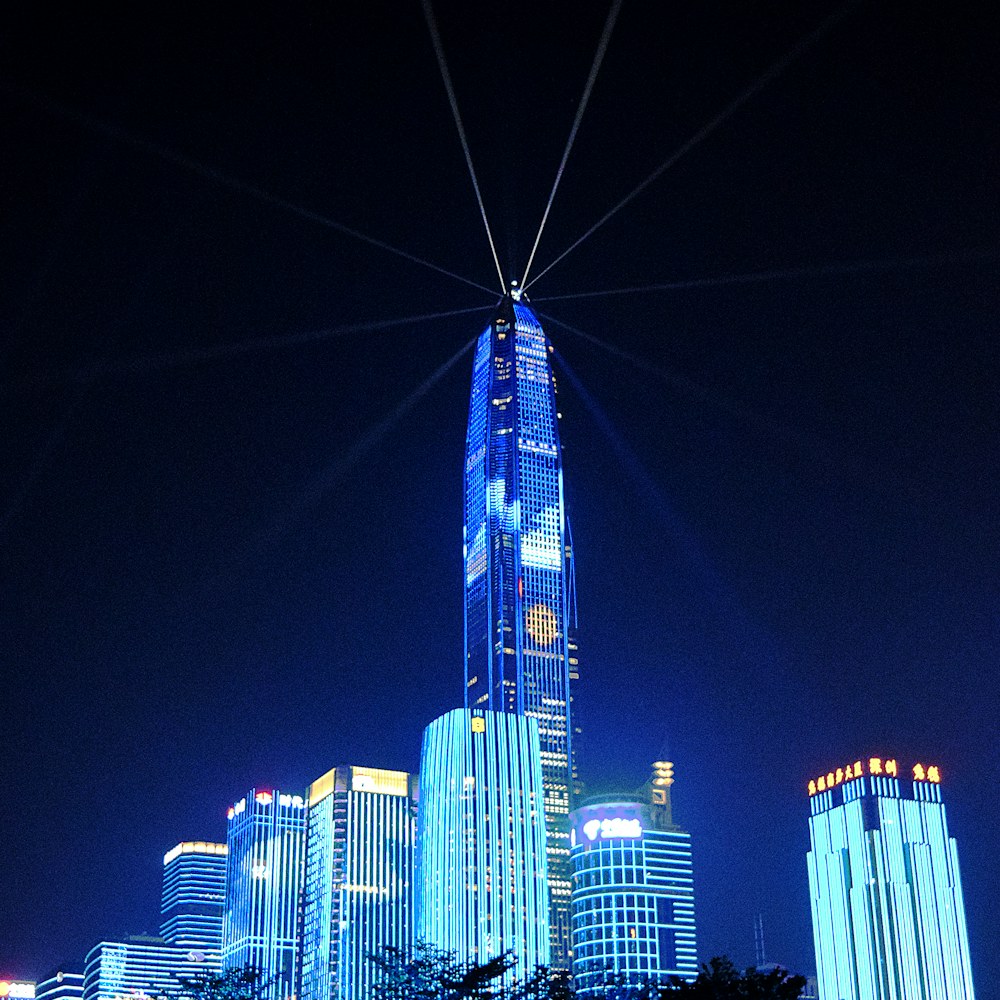
After 19:00 the towers of Futian run coordinated light sequences, and the plaza at Excellence Center is the easiest place to stand and watch all of them at once.
📍 Excellence Center plaza, Futian
🕐 30 min after 19:00
💸 Free
📍 深圳市福田区 卓越中心
Full details
Why it's worth it. Because it costs nothing, needs no planning, and closes the day properly. Finish dinner, walk the plaza for half an hour, and go to bed.
The schedule, because this is where people get it wrong. The towers only run the full animated sequence on Friday and Saturday nights and public holidays — three shows of about 15 minutes at 19:00, 20:00 and 21:00 from November to March (19:30, 20:30 and 21:30 from April to October). On any other night you're looking at ordinary office lighting. Standing on the Civic Center plaza itself needs a free reservation on the 福田中心区夜景灯光预约导引服务 mini-programme; the Lianhuashan summit and the streets around Excellence Center don't. Rain, typhoon warnings or a big event on the plaza cancels it — the mini-programme carries the day's announcement.
Your 3-day future-tech trail
Each stop below carries the time I’d actually give it as a visitor — not how long it stays open. Add the stays to the rides in between and the whole thing lands at about 18 hours at the stops and 5–6 hours in transit. That’s two near-full days of touring plus one deliberately light museum half-day, which is exactly why this is a three-day block: a fourth day would be padding, not sightseeing.
At the stops
In transit
Stops on the trail
Tickets to buy ahead
~18 h
~5 h
12
3
Day 1 · Nanshan by day, Bao’an bay wheel by night — drones, 3D and the skyline after dark
Arrival day · maker culture in the south, then across the bay for Shenzhen’s tallest wheel after dark
Time
Stop
Time there
10:00
DJI Flagship Store, Happy Coast — fly the sims, handle the foldables, stare at the industrial drone wall
70 min, then 15 min ride
11:25
Bambu Lab, MixC — the 3D-printed miniature city; time it right and a printer is running
30 min, same mall
12:00
Lunch in the MixC basement — conveyor sushi if you want the novelty
55 min
12:55
inno100 — crowdfunding hardware next door: walk it, don’t expect to play; a demo only happens if you’ve asked ahead
30 min, then 20 min taxi
13:45
Talent Park drone pad — order a milk tea by app, watch it land, then walk the bay
30 min + walk
14:30
Across the bay to Happy Harbor, Bao’an — metro or taxi, about 40 minutes
40 min ride
15:10
Happy Harbor waterfront — coffee or an early seafood dinner by the bay as the wheel looms
60 min
16:30
Bay Glory Ferris Wheel — ride it after dark for the lit skyline and the estuary
45 min, then walk
18:00
Dinner at Happy Harbor, or stroll the promenade
75 min
19:15
《鲲鹏之梦》 water-and-light show on the plaza — free, 20:00 weekdays, 19:30 & 20:30 weekends, dark Mondays
30 min
19:45
Metro back to Gangxia North
40 min ride
At the stops ~7 h · Transit ~2 h · Back by 20:30
💡
The bay wheel caps the arrival day
Day 1 stays flat and indoors until mid-afternoon, then crosses to Bao'an for the wheel after dark — an easy first day that still ends on a view, not an early night. If you'd rather not cross the bay, the Apollo Go driverless taxi from Talent Park to Sea World is the stay-in-Nanshan alternative.
Day 2 · Futian, Bantian, Longhua — robots, electronics and a light show finish
Full day · step out of the Gangxia North hotel for the morning’s electronics, then one hop north to Bantian
Time
Stop
Time there
09:30
Gangxia North “Shenzhen Eye” — out the hotel door; look up at the dome, the midday light column is dead vertical around now
30 min, then 5 min metro
10:15
Huaqiangbei — SEG Plaza → Huaqiang Electronics World → Museum, in that order; it’s more fun once you’ve seen the components
90 min
11:45
Orbit One lunch — meals arrive by magnetic-levitation UFO, a short hop from Huaqiangbei · ¥80–150
90 min, then 30 min metro
13:15
Robot 6S Store, Bantian — four floors, and the ¥49 entry actually lets you drive things
75 min, then 10 min walk
14:45
Bore Zen Temple, Yabao Park — copy a sutra, meet the little monk; ten minutes from the robots, 700 years away
45 min, then 30 min metro
16:15
Back in Futian — coffee and the plaza at Excellence Center while it’s still light
30 min
17:15
Dinner in Futian
60 min
18:30
Futian CBD light show — towers in shifting colour once it’s properly dark; Friday, Saturday and public-holiday nights only
30 min
At the stops 7 h 30 m · Transit ~1 h 45 m · Done by 19:00
💡
The only day that needs an early start
If the temple's sutra-copying window doesn't work out, you get 45 minutes back — spend it under the Gangxia North dome, which is five minutes from the hotel. And check the day: the Futian towers only run their full sequence on Friday and Saturday nights and public holidays. On a Tuesday you get plain office lighting, so take the 19:00 slot at Talent Park or the Sea World fountain instead — both are a short metro ride from the plaza.
Day 3 · Guangming — the mega museum, half a day
Light half-day · the one stop genuinely worth a return trip; done by early afternoon
Time
Stop
Time there
08:15
Metro Line 6 out to Guangming — sit on the left for the run over the reservoir
45 min ride
09:00
Shenzhen Science & Tech Museum — 950 exhibits over six floors; pick three halls and accept you won’t see the rest · ¥50 · timed entry, book 3–6 days ahead, closed Mondays
3 hrs
12:00
Lunch at the museum café — the only food on site, and worth not leaving for
45 min, then 50 min metro
~13:00
Back in the city — your departure, or a free afternoon
—
At the stops 3 h 45 m · Transit ~1 h 35 m · Done by ~13:30
🎟️
Book the museum slot before you book the flight
The Science & Technology Museum sells out days ahead and is closed Mondays. Slots drop at 20:00, roughly three to six days out — set an alarm for your date and book the moment they open.
Only got 2 days? Or a spare 4th?
Two days. Run Days 1 and 2 exactly as written and skip Day 3. You keep 11 of the 12 stops and every hands-on moment — the wheel is now a Day 1 nightcap and Orbit One a Day 2 lunch, so the only thing you give up is the Science Museum, the one place genuinely worth a return trip.
Four days. Add the Dapeng coast: Shenzhen Observatory (reserve ahead) and Xichong beach. Ninety minutes on site, three hours of driving. It’s the only non-tech day here, and the one thing the four-day version of this trip had that this one doesn’t.
🚌
Not on the trail
A few stops sit off the route for geography, not for quality. The B888 driverless minibus runs in Luohu — worth a reservation if you land at Luohu Port or you're staying downtown. The sightseeing bus loads at World Window in Nanshan, so it slots into Day 1 if your feet give out. Apollo Go is the Day 1 swap if you'd rather stay south than cross the bay for the wheel. None of them is worth building a day around.
Night shows and the APEC fortnight
Shenzhen’s best evening entertainment is free, outdoors and over in fifteen minutes. The catch is the calendar: most of these shows run Friday and Saturday nights plus public holidays only, so a Tuesday in Shenzhen looks disappointingly dark. Times also shift with the season — from November to March the first show is at 19:00, from April to October at 19:30.
Show
Where to stand
Nights
Times (Nov–Mar)
Futian CBD towers
Civic Center plaza (free booking) or Lianhuashan summit (no booking)
Fri, Sat, public holidays
19:00 · 20:00 · 21:00, ~15 min each
Talent Park & π Lake
星光桥 (Starlight Bridge), Nanshan
Fri, Sat, public holidays
19:00 · 20:00 · 21:00
Sea World fountain
The water plaza in front of the Minghua ship, Shekou
Tue–Sun
Every 30 min, 19:00–21:00 (to 21:30 Fri/Sat)
Happy Harbor water show
Celebration Plaza, Bao’an
Tue–Sun, dark Mondays
20:00, plus 21:00 at weekends
Pick one a night, not two — the transit between them eats the whole window. And take the 19:00 slot when you can: it’s the one that leaves you a metro ride home rather than a taxi.
What APEC is, where it’s held, and whether you can get in
APEC — Asia-Pacific Economic Cooperation — is the annual meeting of 21 economies around the Pacific rim, from China and the US to Chile and Papua New Guinea. It isn’t a treaty body and it can’t bind anyone: everything is by consensus, and a year of ministerial meetings and working groups funnels into one leaders’ summit. Shenzhen 2026 is the 33rd of those and the third hosted by China, after Shanghai in 2001 and Beijing in 2014. The theme this year is “building an Asia-Pacific community to prosper together”, which in practice means trade, supply chains, the digital economy and AI.
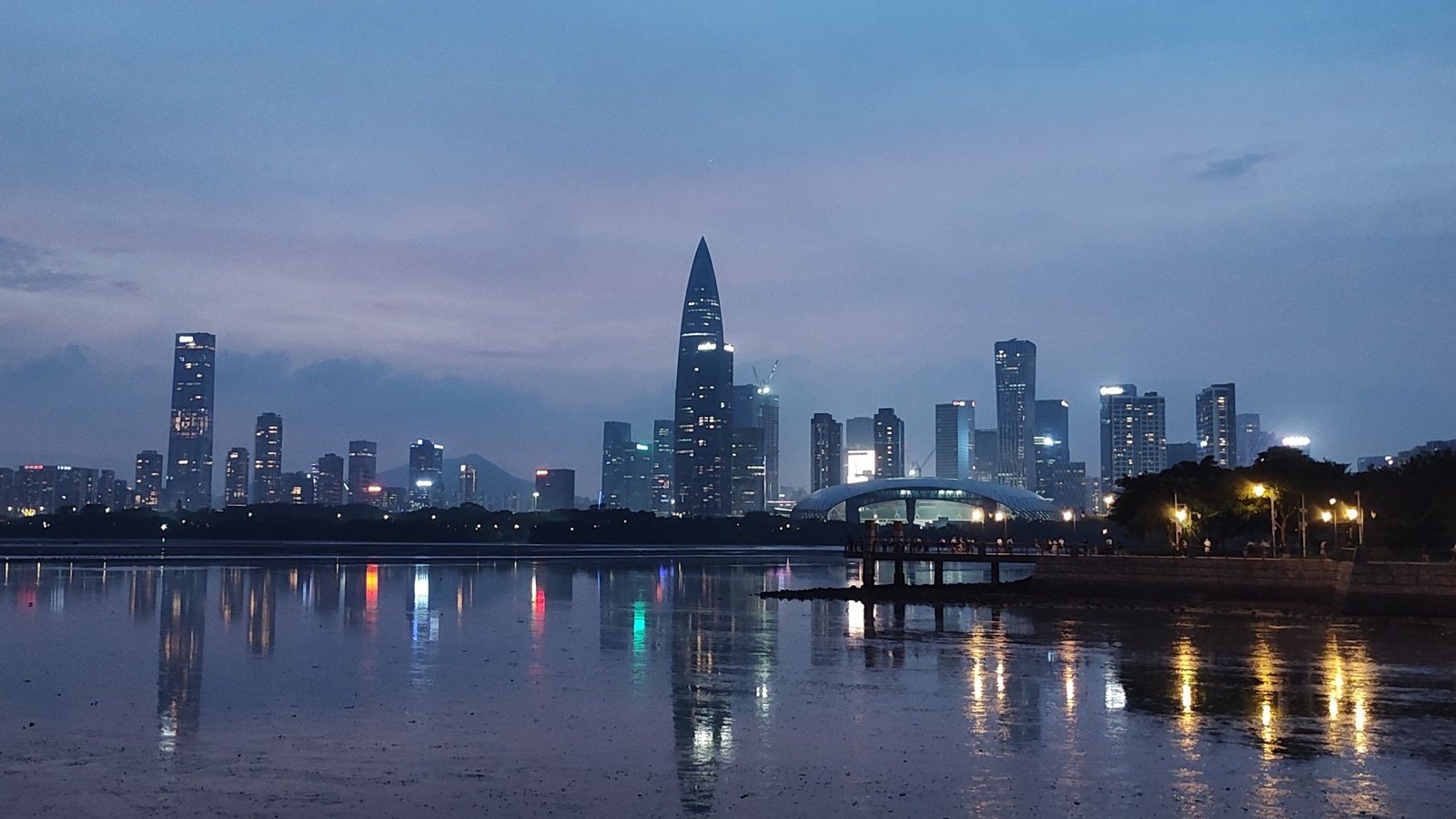
Where. The main venue is the Shenzhen International Exchange Center (深圳国际交流中心), on the northeast corner of Hongli Road and Xiangmihu Road in Futian — 430,000 m² built on the site of the old Xiangmihu resort. Xiangmei station (Line 9, Exit D) is about ten minutes on foot; from Nonglin (Line 7, Exit C) you walk in through Xiangmi Park. It is not the Futian exhibition centre in the CBD — that’s the mix-up to avoid.
Tickets. There are none. This is a closed meeting of delegations, not a public event: the venue is fenced, the roads around Xiangmihu are controlled, and there is nothing to buy or walk into. The city around it is the part you get — bilingual banners down Shennan Avenue, a flower sculpture on the kite lawn at Lianhuashan, the light shows above.
Can you just go and look at it? On a normal day, yes — from the outside. The hall itself is closed to visitors, and there is no tour to join, but the lakefront and Xiangmi Park stay open to anyone: the boardwalk, the lawn, the pavilions, no ticket. The building sits low behind the treeline, so the view from the far bank is the one people come for, best an hour before sunset when the roof picks up the light. The operator has said the congress hall, pool and sports courts will be opened to the public on a regular basis once the summit is done, but no date has been announced — don’t plan a trip on it. During the summit and the control period around it, treat the whole Xiangmihu block as shut: you won’t get near the water either.
Is it worth the detour? Only if you’re already there. It’s a conference centre in a park — a fifteen-minute look from the lake side, not a stop worth crossing the city for, and nothing about it changes if you skip it. Go on a clear evening when you’re walking Xiangmi Park anyway, or when you want the “this is where APEC happened” photo. The night shows in the table above are the better use of the same evening.
🎇
APEC week: 18–19 November 2026
The leaders' meeting itself runs 18 and 19 November 2026. The city spent the year rebuilding its waterfront for it, and the visible payoff is the new water-screen show on π Lake at Talent Park — a ring of fountains firing jets up to 80 metres, laser and projection thrown through the mist, the Houhai towers standing behind it. It was still in rehearsal in early November 2026, so the Friday/Saturday pattern above is the safe bet and anything extra is a bonus.
For a visitor the trade-off is traffic. The city holds temporary powers over roads, security and public transport until 30 November 2026, and the official ask is to leave the car behind and use the metro. Expect exit closures and bag checks near the venues, hotel rates up around Shenzhen Bay and Futian, and a city that has been formally asked to leave the car at home that week. If your dates are fixed to that fortnight, book the hotel early and keep Day 1 loose — Apollo Go and the driverless minibus are the two things most likely to be rerouted.
If you’re here outside those two nights, none of this changes your trip: the city runs the same shows every weekend through the winter, and in a normal week you’ll have the plaza half to yourself.
Practical tips that actually matter
Trimmed from two real four- and five-day trips down to three. Stop timings are my own estimates for a typical visitor — how long you’d actually want to stay, plus the ride to the next stop — not published figures. Prices are in yuan with dollars alongside at roughly ¥7 = US$1; treat the dollar figures as planning estimates, not a rate you’ll be quoted. Ticket rules and opening days change, so verify before you book.
💰 What it actually costs
Roughly ¥2,200 (≈ US$315) per person for three days and three nights — hotel share, food, tickets and metro.
Item
CNY
≈ USD
Robot 6S Store entry
¥49
$7
Science Museum, main halls (cinema +¥30)
¥50
$7
Drone-delivered meal (two boxes + delivery)
¥30–70
$4–10
Bay Glory Ferris wheel
¥150
$21
Sci-fi meal at Orbit One, per person
¥80–150
$11–21
Metro, all three days
¥45–90
$6–13
Mid-range hotel, per night per room
¥400–700
$56–99
Other meals, snacks, the odd taxi
¥600–900
$86–129
3-day total, per person
~¥2,200
~$315
The hotel is the only real swing — waterfront five-stars hit ¥3,000+ (US$420+) a night around holidays, while a Futian business hotel costs a fraction of that. Nearly every tech stop on this list is free to walk into.
🏨 Where to stay
Base in Nanshan or Futian — central to every cluster.
A tested pick: a hotel by Gangxia North exit 13 — twenty metres from the “Shenzhen Eye” hub, direct on Line 11 to the airport, four lines crossing underneath, and a five-minute walk to breakfast. Staying put in one hotel rather than moving keeps a multi-generation trip sane.
🚇 Getting around
Metro is king. One traveler did five days here on transit with two taxi rides. Shenzhen’s network is cheap, air-conditioned, signed in English, and reaches every stop on this page.
Download Baidu Maps (or Amap) and Alipay / WeChat Pay before arrival — see our guides to Alipay, WeChat Pay and Chinese metro systems. Both driverless options are booked in-app rather than hailed: Apollo Go (萝卜快跑) for the paying taxi in Nanshan, 深巴出行 for the free B888 minibus in Luohu.
Taxi drivers rarely read English. The Chinese address under every stop exists for exactly that reason — copy it into your notes or hand over the phone.
📅 Book ahead
Science Museum — timed entry only, closed Mondays; slots drop at 20:00 about three to six days out.
Shenzhen Observatory — free but reservation-only via the official WeChat account; 300 places a day, released Mondays at 10:00.
Bambu Lab printing class — same-day sign-up only, at the store, ten seats a session.
Orbit One — reserve a “planet” booth at weekends.
B888 driverless minibus — free but reservation-only on 深巴出行; three vehicles, six seats each, no walk-ups.
Bay Glory — buy the wheel on the official mini-programme to skip the ticket queue.
❄️ If you’re coming in winter
Pack a light layer, not a parka. Days hover 15–22°C, nights fall to around 10°C. A windproof shell covers both.
Rain is scarce from December to February, so coastal days are usually a safe bet.
Chinese New Year (17 February 2026, 6 February 2027) closes small shops and spikes transport. Big museums stay open but book out solid.
Sunset is early — about 17:45 in December — so front-load outdoor stops and save the museums for the afternoon. If you want the Bay Glory night ride plus the free plaza water show, aim to be at Happy Harbor by around 19:00 — the 《鲲鹏之梦》 show runs at 20:00 on weekdays, 19:30 and 20:30 at weekends.
Yes — arguably it's the best season. December to February is dry, bright and mild at 15–22°C, and almost everything on this list is indoors, so a cold snap costs you a plan B rather than a day. The one window to dodge is the week around Chinese New Year, when transport and hotels hit their annual peak.
Do you need to book the Science & Technology Museum in advance?
Yes, and it's timed entry with no walk-up tickets. Book on the museum's official WeChat mini-program, or through Meituan, Dianping or Ctrip. Slots are released at 20:00 about three to six days ahead; weekend mornings disappear within minutes. Mondays are closed, and you enter by ID — bring the passport you booked under.
How many days do you need for Shenzhen's tech scene?
Three. The stops themselves are short — 45 to 90 minutes each, with the Science & Technology Museum the only one that wants three hours — but the city is long and the clusters are far apart, so budget roughly 18 hours at the stops and 5 hours in transit. That's two full days plus a light arrival half-day. Two days works if you drop the museum; a fourth only pays off if you add the Dapeng coast.
How much does a 3-day Shenzhen tech trip cost?
Roughly ¥2,200 — about US$315 — per person for three days and three nights, including a shared mid-range hotel, food, metro and every ticket. The pleasant surprise is how little the tech itself costs: most stops are free to enter, the robot 6S store is ¥49 (US$7), the science museum is ¥50 (US$7), the Ferris wheel is ¥150 (US$21), and a drone-delivered lunch runs ¥30–70 (US$4–10).
How do you actually ride a driverless taxi in Shenzhen?
Apollo Go (萝卜快跑) runs fully driverless paid rides in Nanshan, Bao'an and Pingshan — not in Futian — so the nearest pickup for most visitors is the Shenzhen Bay Sports Centre south gate (深圳湾体育中心南门), a ten-minute walk from Houhai station exit M on Lines 2, 11 and 13. Order on the 萝卜快跑 mini-programme inside WeChat, pick from the fixed stops, then type the last four digits of your phone into the panel on the door pillar. Rear seats only, seatbelt on or it won't move. Fares run ¥10–30 and the service runs 24 hours. For a free alternative, the B888 driverless minibus leaves Luohu Port every 25–30 minutes between 08:30 and 19:00 — free, but reservation-only on 深巴出行.
When is APEC in Shenzhen, and will it affect my trip?
The 33rd APEC Economic Leaders' Meeting runs 18–19 November 2026 at the Shenzhen International Exchange Center in Xiangmihu, Futian — and no, there are no public tickets: it's a closed meeting and the venue is fenced off for the two days. Outside the summit the lakefront park and Xiangmi Park are open and you can look at the hall from the far bank, though there is no visitor access inside. The city holds temporary powers over traffic, security and public transport until 30 November 2026, so expect road controls and metro exit closures near the venues, higher hotel rates around Shenzhen Bay and Futian, and bag checks at big attractions. The upside is the extra night shows built for the summit — above all the new water-screen show on π Lake at Talent Park. If your dates are fixed to that fortnight, book accommodation early and give Day 1 some slack.
Do you need to speak Chinese?
Less than you'd think. English thins out away from hotels, but Alipay and WeChat Pay translate menus and messages in-app, Baidu Maps or Amap handles navigation, and the big attractions carry English signage. Every stop below ends with its Chinese address — copy it into your notes or hand it to a driver.
 1
Drones & Robots